Tuesday, 20 November 2018

I used to live in the nearby village of North Petherwin, in a converted barn by the pretty church of Saint Paternus. Before I lived there, I always thought I would find being so close to a graveyard unsettling, but nothing untoward was even seen amongst the headstones and I felt completely at ease there.

The village was quiet, with an old chapel now acting as a house, the local shop likewise, and both the pub and shop actually residing short drives away. There was an old schoolhouse that now served as the parish hall, and an adjacent playground that had long seen better days. The church rectory was by far the most handsome building in North Petherwin, but had been turned into a nursing home. A dirty old garage completed the community. The kind of place that never quite managed to fix your car properly.

Certainly, there were no ghosts or ghoulies!

North Petherwin Church: The Author Used To Live Next Door

The same is not true of South Petherwin which, as its name suggests, lies the other side of Launceston. For that tiny village, boasting also a church dedicated to the otherwise unheralded Saint Paternus, was once the scene of a very strange affair. A haunting so singular that it has become known throughout the land.

THE GHOST OF DOROTHY DINGLEY

We know the Reverend John Ruddle was once vicar at Saint Mary Magdalene church in Launceston, for there is a memorial to his leaving this world hanging upon one of its walls. There are the usual idle boasts of piety and claims he was a friend of the poor, but the tablet does him no justice in regards to his greatest adventure, which is strange, seeing as he wrote in detail about it himself. Indeed, much of the following tale is in his own words...

St Mary Magdalene Church, Launceston
Having preached at a funeral of a young boy on 20th June 1665, John found himself accosted by a gentleman who, "with an unusual importunity, almost forced against my humour, to see his house that night."

Now, the Reverend Ruddle was  man of strong character, and he resisted the demand,a greeing only to visit when it suited him. When eventually he did, he discovered that the gentleman's son was acting most melancholy. It was put to him that he might ascertain what lay behind his moods.

The boy confessed that he believed himself haunted by a ghost!

One Dorothy Dingley, sometimes referred to as Dinglet, had been a neighbour in life, so the boy knew her well. She had passed away some eight years previously, yet, according to the lad, he saw her daily. He said, "She never speaks to me, but passes by hastily, and always leaves the footpath to me, and she commonly meets me twice or three times in the breadth of the field."

Countryside Near South Petherwin
Such fear was beginning to sieze the boy's heart that John Ruddle determined to do something about the apparition. But if he had doubts about the veracity of his claims, they were soon dispelled. Walking alongside the boy in a field of some twenty acres or so, about three furlongs from any house, he saw the ghost for himself.

"We went into the field, and had not gone about a third part, before the spectrum, in the shape of a woman...met us and passed by. I was a little surprised at it, and though I had taken up a firm resolution to speak to it, yet I had not the power, nor indeed durst I look back."

Three weeks later, and his courage fortified by prayer, and perhaps something a little more of this world too, John returned to walk the field alone. Again he saw the ghost, but too far away to speak with it. The following day, in the company of the boy and his parents, he tried once more. The attempt was unsuccessful because the ghost travelled too quickly to be caught. Indeed, John wrote, "I dare aver, that the swiftest horse in England could not have conveyed himself out of sight in that short space of time."

He also noted two facts about the haunting.

"1. That a spaniel dog, who followed the company unregarded, did bark and run away as the sprectrum passed by; whence it is easy to conclude that it was not our fear or fancy which made the apparition.
2. That the motion of the spectrum was not gradatim, or by steps, and moving of the feet; but a kind of gliding as children upon the ice or a boat down a swift river."

The following morning, he finally succeeded in making contact with the ghost. More than that, for he enjoyed a conversation of sorts with Dorothy's spirit, which resulted in her disappearing once and for all. Curiously enough, John Ruddle was somewhat vague in this, the most exciting, part of his account, saying only, "...after a few words of each side it quietly vanished; and neither doth appear since, nor will ever more to any man's disturbance. The discourse in the morning lasted about a quarter of an hour."

Such strange reticence can be attributed to kindness and discretion. The Reverend John Ruddle was a man of the cloth and well used to hearing people's confession. Although in this case the voice was that of a ghost, he happily granted peace and absolution all the same. He never broke her confidence, but Dorothy's tale eventually became known throughout the area. An interesting tale it was too.

The young man haunted went by the name of Sam Bligh, the 16 year old son of a wealthy farming family, able to trace their line to the Norman conquest. Their seat was Botathan House in South Petherwin, which had come into their possession during the late 1300s, following a fortuitous marriage.
Dorothy Dingley, Before Tragedy Struck
Poor Dorothy boasted no such favours of birth. She is believed to have been a poor, illiterate serving girl who Sam's elder brother got into trouble. Tragically, she died in childbirth at much the same time he was sent away from the area.

The reasons for her haunting young Sam can only be guessed at, but it is thought that she needed to confess her 'sin' before feeling able to move over to the other side. An alternative explanation is that she required her former beau to make his own penance, for having treated her so appallingly. Only then could she find peace. Whatever the case, John Ruddle was able to satisfy Dorothy and she was never heard of again.

The name of this blog is true(ish) ghost stories of Devon and Cornwall, yet there can be no doubting the honesty of this tale. For as John Ruddle himself said, "...until I can be persauded that my senses do deceive me about their proper object, I must and will assert that these things are true."

Monday, 19 November 2018

The Ancient Capital of Cornwall

Travelling from the East, the first Cornish town visitors come across is Launceston. It is a small place, with very little happening, but was once the capital of the Duchy. An important town indeed, with a church founded by the legendary Black Prince, and a castle overlooking the roads to Cornwall. Once upon a time, Launceston also boasted a priory dedicated to St Augustine, whose possessions included vast estates on both sides of the Tamar. As with other rich religious houses, the priory was forced to close by King Henry VIII.

Needless to say, a town with such a long and turbulent history is home to more than one spectral tale.
Dockacre House
The most famous ghost story involves Dockacre House, an Elizabethan mansion on the old road into town. Just over three hundred years ago, Sir Nicholas Herle bought the house to reside in finery with his wife Elizabeth. However, before the year ended, she was dead. A memorial plaque in the town church claims she was killed by starvation or other unlawful means. Which wasn't enough to prevent her widower going on to become mayor of Launceston and the High Sherriff of Cornwall.

When he died, his own obituary included this startling statement. Nicholas had apparently endured “The misfortune to accidentally shoot his lady.

Interestingly enough, another variant on the couple’s unhappy life has her suffering from madness and thus being boarded up in a locked room. A further tale reverses the roles quite unexpectedly. In this retelling, Sir Nicholas is the victim of her violent cruelty.

Whatever happened at Dockacre House (indeed, if anything tragic ever did) the historic residence is known to be haunted. The ghost of Nicholas Herle has been spotted playing a wooden flute. His tune is recognised as an Elizabethan song containing the following words:

Since that I saw your face I resolved,
To honour and renown you.
If I be now disdained I wish,
My heart had never known you.

As in life, so in death, the stories surrounding this mysterious house remain confused and contradictory. For a recent occupant told me it was actually a lady who haunted it. She told me the local postman was so sure he’d seen a ghostly woman in one of the upstairs bedroom windows, he now refused to deliver mail there.

That was during 2010 and Dockacre House has since changed hands. Whether the ill-fated Elizabeth Herle or her possibly murderous husband remain, I cannot say. Nor can I confirm whether the present owners still have to pick up their letters from the local post office!


The patron saint of Launceston is one Cuthbert Mayne, former priest and Catholic martyr. The town’s Catholic church is named after him and a stone on the old market square commemorates the spot where he lost his life. For Britain in the 16th century was no place for the tolerance of other men’s faiths and Mayne, having secretly trained at a seminary in France, found saying Mass reason enough to be arrested for treason. His trial at Launceston was a sham, which even the notorious ‘Hanging Judge Jeffries’ called a miscarriage of justice.

Sentenced to being hung, drawn and quartered, Mayne suffered horribly at the hands of an especially sadistic executioner. Fixing the hangman with a stare, he claimed that he would himself be dead before the year was out. Sure enough, the curse was effective because he did indeed die shortly afterwards, having first gone insane.

When people talk about ghosts, they almost always refer to tales from days gone by. I wonder why this is, when there are still plenty of hauntings taking place now.

Merryn Turner's Haunted House
Remaining in Launceston, an interesting claim reached the ears of the local press in the August of last year. One Merryn Tuner, who’d recently moved into a 1950s house on the council estate of Lanstephan, said her new home was haunted.

Merryn and her partner noticed unusual sounds within a few weeks of living there. To begin with, they took the form of mumbling voices and people talking upstairs. It soon progressed to the sound of children singing, yet when they checked on their own little ones, they found them fast asleep. Lights started flickering, doors were rapped by invisible hands, and objects fell noisily of their own accord.

“I thought I heard my daughter getting out of bed,” Merryn told a reporter. “I expected her to knock at my bedroom door. There was a knock at my door and I opened it, but she wasn’t there. I went to check on her in her room and she was out cold asleep...Then I heard someone call ‘Mummy’.”

Of course, such a new building boasts little history, so who are these childhood spirits? Lanstephan is a modern estate; it was fields until recently, verdant Cornish countryside. One can therefore only speculate on their origin.

I like to think they are merely the innocent reminders of kids who once played in the fields the estate buried beneath concrete. Enjoying, as they did in life, games of chase or hide and seek. Spirits that perhaps play the timeless mischief of Nickanan Night, now that a modern house stands in their path.


Saturday, 10 November 2018

The Most Famous Of All Devonshire Ghost Stories

DARTMOOR'S HAIRY HANDS

The most famous of all Devon's ghost stories is probably also her most bizarre. For high upon Dartmoor, amidst the wild and scenic splendour of this desolate place, a peculiar peril exists. It is a danger unique to this haunted corner of the island, a threat unheard of elsewhere. It is claimed that more than one person has been injured as the result of this apparition, some have even lost their lives.

What I speak of, are the notorious hairy hands.

A lonely road winds its way like a stream over the empty moorland above Princetown. Beside this remote turnpike, the ruins of powder mills can be seen, all that remains of an old gunpowder factory. The men behind the venture chose its location well, for they knew the risks involved in manufacturing their deadly product. It was therefore situated far from anyone else, lest it ever fall victim to a stray spark or stroke of ill luck. A wise decision, as it turned out, for there were a number of explosions in the 1850s, which resulted in the deaths of a handful of workers.

We know from newspaper reports that one poor soul left behind a wife and five children; that two others who were killed went by the English names Dodd and Hamlyn.

It is also claimed that an Italian lost his life during one of the accidents. Legend speaks of him as the source of all following troubles.
Moving forward a number of years, and local people have become wary of travelling the road alone or at night. They claim an unseen presence grips the handlebars of their bicycles and forces them off the road. Traps are upturned as leading ponies feel their reins pulled to the side. It is as though some unworldly malevolent force wishes revenge on the living for its own premature death. However, it is with the advent of motor vehicles that matters spiral beyond control.

Winter 1921 and Dr Helby from Princetown travelled by motorbike and side car, his two children passengers in the latter. The motorbike suddenly veered from the road where it crossed the Cherrybrook, a small river spanned by an old stone bridge. The children were thrown from the sidecar but poor Dr Helby was killed on impact. No mechanical faults were found on his vehicle. No explanation ever provided for the crash.

Not long afterwards, an army officer from the nearby Okehampton Camp experience something similar. Riding along the road at night, his motorcycle was suddenly forced from the tarmac. Although injured, he survived the incident. He told police and army superiors alike that as his handlebars were gripped by a pair of large, disembodied hands, that steered it into danger. The hands were described as muscular, and far too strong for him to wrestle off. Muscular, disembodied and hairy.

Modern minds might scoff at such claims, but they made headline news at the time. They were covered in no less a publication than the Daily Mail. The authorities took them seriously enough to send engineers to investigate. Those experts' prosaic conclusions were that the crossing over the Cherrybrook, involving an unusually sharp camber, was to blame.

And yet changes to the road did not prevent further incidents. A charabanc trip to the moor ended in tragedy when the coach swerved inexplicably off the road, resulting in several passengers being thrown from their seats. The driver claimed that a pair of ghostly hands grabbed his wheel and took malicious control of the coach.

A car was also found upturned at the site, with its driver dead at the wheel. No cause for the crash has ever been established.

Perhaps most alarmingly of all, in 1924, a woman holidaying in the area witnessed the hands try to gain access to her caravan. Her name was Theo Brown and she would later write about the experience in a book. In her own words then:

I knew there was some power very seriously menacing us, and I must act very swiftly. As I looked up to the little window at the end of the caravan, I saw something moving, and as I stared, I saw it was the fingers and palm of a very large hand with many hairs on the joints and back of it, clawing up and up to the top of the window, which was a little open.

I knew it wished to do harm to my husband sleeping below. I knew that the owner of the hand hated us and wished harm, and I knew it was no ordinary hand, and that no blow or shot would have any power over it.

Almost unconsciously, I made the Sign of the Cross, and prayed very much that we might be kept safe. At once the hand slowly sank down out of sight, and I knew the danger was gone. I did say a thankful prayer and fell at once into a peaceful sleep.
Most people nowadays laugh off such claims, for it is easy to mock from the safe distance of a centrally heated house, protected from the world by locked doors and double glazing. Yet there are those upon Dartmoor who remain convinced there is truth behind the legend. I was fortunate enough to meet one, an elderly widow who ventured inside my old pub one afternoon.

Her late husband had once farmed both Lydford and Cherrybrook way; when I heard the latter, I asked her jokingly about whether he believed in the Hairy Hands. Needless to say, I only teased her, for I didn't set much store myself by the stories being true. The woman's reply therefore startled me.

"He didn't just believe 'em, bey," she said, "He saw 'em for himself."

She went on to tell me that he'd been working upon the moor late one night, and drove back in his tractor, well after dark, to their Lydford farmhouse. At the Cherrybrook bridge, his tractor wheel was suddenly seized by the hairy hands, which proceeded to drive the vehicle off the road and overturn it.

Being a tractor, it was both heavily-built
and driven slowly; he therefore survived the impact. However, he never returned to work that land after dark again.

"He was never frightened of anything in his life," the old woman insisted to me. "Except he was terrified of that place. And whatever evil thing it is that haunts it."

Thursday, 25 October 2018

My Ladye Hath a Sable Coach

THE GHOST OF MARY HOWARD,
MURDEROUS DENIZEN OF FITZFORD HOUSE

Devon Fields by Emma Hunter. A Miniature in Oils.


Think of Devonshire, and a series of images come immediately to mind. This is Ambrosia country, painted green with peaceful rolling hills, pleasant farms and cosy cottages. The coast is dotted with picturesque fishing villages, beautiful beaches and smart resorts. It is beautiful, in a gentle, safe, very English kind of way.

But then along comes Dartmoor, which is anything but these things. Filled with darkly brooding landscapes, magnificent tors and barren wastes, it is a place of melodrama and mystery. A place where it is all too possible to believe in things that should not be.

Pewtor at Sunset
Dartmoor's most famous ghost story involves a much-maligned noblewoman, one who lived during the restoration of the monarchy. Lady Mary Howard, daughter of the dissolute Sir John Fitz, had a difficult life. Indeed, she was only nine when her father committed suicide.

Few in Tavistock mourned his passing, for John was bad to the bone. Having inherited vast estates on the border of Devon and Cornwall, he made the most of living above the law. Having already murdered one man during a drunken squabble, his best friend Sir Nicholas Slanning, he killed a second near London before stabbing himself in the chest.

As was the way in those days, Mary was taken from her remaining family and made a ward of court. In all essence, she was sold to the highest bidder, that they might marry her estates and claim them for their own. As such, she found herself wed at the tender age of twelve to the Earl of Northumberland's brother. There was of course no love involved in the arrangement. The Earl had bought the role of "protector" of the girl due to her great wealth. His brother owing Earl Percy vast sums of money, he was ensuring a way of having the debts repaid.

In fact, the husband died without Mary ever seeing him again. Still a child, their marriage happily unconsummated, she heard the news from afar that he had passed away. It was to be the first of four marriages, only one of which was actually made for love. Although one of these unions ended with divorce, the other three concluded with poor Mary being widowed.
The Much-Maligned Mary Howard

Such misfortune might have made local people pity her, but they did not. The Fitz name had been blackened irrevocably by her father's actions and now people suspected the same of her.

"Afterall, the apple doesn't fall far from the tree," they would whisper. "Three husbands dead....and now also a child in the grave. Perhaps Mary inherited murderous passions alongside her parent's wealth."

All of which explains her presence as a most terrible apparition.

Each night, Mary's corpse leaves Fitzford Gatehouse in Tavistock. Her carriage is composed of the bones of her murdered husbands and children. It is pulled by skeletal stallions, whipped into a frenzy by a headless horseman.

Any who witness it race towards another family possession, the ruined castle at Okehampton, are cursed to die themselves. But why, you might ask, must Mary's ghost make this nightly journey?

It is punishment for her earthly crimes. She is condemned to enact a fruitless task, to pluck bare the castle mound of grass, one blade at a time, before sunrise. Only when the chore is complete will her soul know eternal rest, but it is of course a quite impossible mission. She therefore repeats the journey each night, as she has for the past 346 years. It is a journey she is doomed to repeat until the end of time.

My Ladye hath a sable coach,
And horses tow and four;
My ladye hath a black blood-hound
That runneth on before.

My ladye's coach hath nodding plumes,
The driver hath no head;
My ladye is an ashen white,
As one that long is dead.


The Gatehouse...All That Remains of the Fitzford Estate
Okehampton Castle Ruins

A Postscript to this Tale...

There are two interesting footnotes to this story. The first involves my time managing The Royal Standard public house in Mary Tavy. The moorland village lies astride the former King's Highway, the one-time coaching route linking Tavistock to Okehampton. Should the tale of Marys spectral coach be true, she might be seen from the pub's windows late at night.

Of course, I never saw anything of the sort but the building was haunted by a ghostly woman. Not only I saw her, so did my daughter Charlotte, a barmaid named Katrina and an old flame of mine, Jennifer from Manchester. The impression I got each time was fleeting: more a hint of a woman, than a woman herself. The one thing I did notice was that she was clothed in gold dress, possibly a ball gown. Why such an elegant personage should haunt a tin miner's drinking house is unknown.

One of my regulars, the resident of a neighbouring cottage, told me the pub was known to be haunted in this way. She said it was believed that the ghost was Lady Tavistock. In other words, none other than the infamous Mary Howard!


Before ever I'd taken the pub on, I began writing a book called The Children of Powerful Men. It is a Celtic crime novel, set upon Dartmoor and the romantic Cornish coast, and it features an array of characters from both the history and folklore of the area. By serendipity, fate or coincidence, Sir John Fitz, his victim Nicholas Slanning, and poor Mary's mother Brigit all play prominent roles. Should you wish to give it a go, it is available on Kindle at The Children of Powerful Men


Tuesday, 23 October 2018

A Quick Half and a Trio of Haunted Pubs

Over the Tamar and into Cornwall, for there is a curious tale to relate about The Tree Inn at Stratton. Long before Bude became a hip surf resort, neighbouring Stratton was an important stop on the coaching route now grandly termed the Atlantic Highway. Its moment making headlines occurred a long time ago, during the English Civil War. For when Charlie’s fun-loving cavaliers planned 1643’s Battle of Stratton, the village inn was their choice of H.Q.

The Tree Inn at Stratton

Sir Bevil Grenville

The royalist troops were led by Sir Bevil Grenville, described as the only man who knew how to handle the Cornishmen. Loving Bevil as only the most loyal soldiers can, they were happy to march into battle against apparently overwhelming odds. That was certainly the case during his attack on Ralph Hopton’s parliamentarians, a skirmish none but himself expected to win.

By his side was Anthony Payne. Standing at 7ft 4in, he was the last of the Cornish giants. After the war, he retired to live at The Tree, dying peacefully in 1691. His coffin was so large, it had to be lowered through a hole made in the roof.

Courtyard at The Tree Inn
I visited this lovely, historic pub six years ago, to drop off beer from the brewery I worked at. Whilst there, I may have been tempted to try a swift half myself…the old memory isn’t as strong as it used to be! However, what I do recall is the interesting tale the then landlady told me about the back bar. It was, she assured me, haunted!

An Ulsterman had the pub at the time, a great, fat fellow; I can’t seem to remember his name. Anyway, it doesn't matter, for it was his wife’s mother who’d seen the ghost, not him. The ghost was an old woman, sat on a chair by the fireplace. In fact, not only did his mother-in-law see the ghost, she even talked to it. Many a conversation she enjoyed with the spectral punter, even though no one else ever heard so much as a whisper from it.
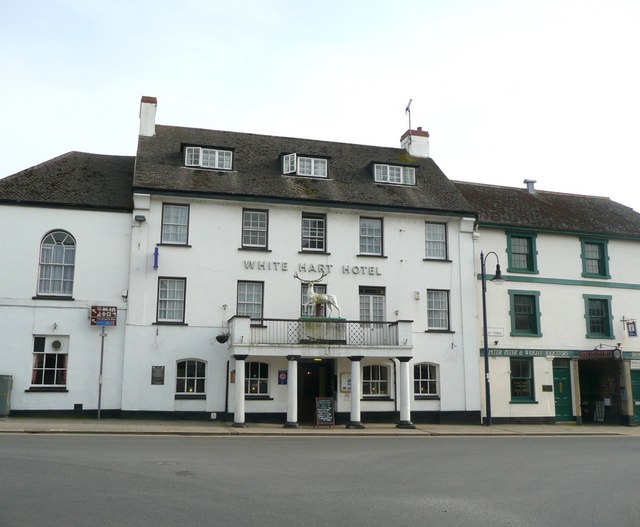
The White Hart Hotel in Okehampton
A similar tale was told at The White Hart in Okehampton. This coaching inn, on the fringes of Dartmoor, must once have offered a very welcome sight to those travelling on inclement evenings, for it provided warmth and shelter of the kind unheard of upon the moor. Yet the tale told was not about the clatter of ghostly hooves, and neither did it involve the spirit of anyone who stayed there long ago. Rather, it was another old lady, one who asked the most prosaic of questions about room rates and the like.

The manager called the young receptionist to his side and dressed her down for not coming to help in the busy bar.

“But I couldn’t leave my post,” she protested. “I was dealing with a customer.”

“What customer?” he scoffed. “There was nobody there.”

“Oh, but there was sir,” she insisted. “An old lady. You must’ve seen her.”

She claimed to have been kept occupied with a veritable barrage of enquiries.

To settle the argument, the manager inspected footage from the CCTV cameras. Nothing was seen save the pretty young receptionist…who chatted merrily away at what appeared to be an empty space!

Chillaton, with the Chichester Arms
Both inns are under new ownership and remain as busy as ever. Sadly, another of the pubs I sold beer to, The Chichester Arms in Chillaton, is no more. It has gone the way of so many atmospheric country pubs, neglected by the village it once served so proudly. Boarded up, it offers just a hint of the great times local people must once have enjoyed there. Occasions so enjoyable that one visitor refused to allow even death to prevent him returning each night.

The Chichester Arms
The name of Charlie, he went by, and every night after closing time he played a trick or two on The Chichester’s last landlady. She told me that he would unlock all the doors whilst she slept, and unplug both the television and Sky box. Each morning, she would wake up to see the wires laid neatly beside each other.

One night, he took his mischief further. The landlady awoke to smell the unmistakeable aroma of cooking fat reach her upstairs rooms. Rushing down to the pub kitchen, she found the commercial fryers switched on.

To my great amusement, she then related to me how she’d chastised the errant spook for his behaviour. Wagging her finger in the air, and adopting the kind of tone one normally uses when addressing an ill-behaved dog, she told Charlie that she didn’t mind him unlocking the front doors, but switching on the fryers was, “stupid and dangerous.”

The dressing down apparently worked, for she told me Charlie never pulled that trick again. Suitably chastened, he reined in his sense of humour and limited his pranks to unlocking doors and loosening cables once more.

Sunday, 21 October 2018

The Witch Bride of Stowford

(A Work of the Imagination, Inspired by a Walk There on Satuday, 20th October 2018)


Stowford is a small village, no more than a hamlet really, not far from Launceston and the border with Cornwall. These days, the grange and manor farms offer no more than hints of the past, what with their barns and stone outbuildings turned into homes for the elderly and well-heeled, but it was once a thriving agricultural community. One that was surprisingly prosperous for its tiny size and remote location.

More than one visitor noted the remarkable affluence of the place. The farms looked handsome and comfortable, exceedingly so. The farmhouses themselves were grand, the cottages offered their labourers comfortable, and there was a surfeit of carts and wagons for bringing produce to market. Harvests were always bountiful, which went some way to explaining how the village prospered whilst all around struggled for a livelihood.


Perhaps most outsiders were not observant enough to notice the strange, dead, stump of a tree standing in a field near the barton. And if they did, they weren't curious enough to remark upon its existence, for it would've struck them as nothing more odd than an old oak probably hit by lightning. In fact, the bleached, limbless entity was far more important than that to the people of Stowford. It was their witch oak. Around whose skeletal trunk were performed the rituals they held responsible for their wealth.

Upon the eve of each cardinal date those villagers met, to enact the kind of rites once celebrated by all in this pagan isle. Witnessed by the rector of St John the Baptist church, they returned to their race's pre-Christian heritage. Although proud of their devotion to the old ways, grateful for the harvests they felt sure were due to heathen acts, they knew to keep their actions secret and hidden from outsiders. In those days of religious zealotry, inquisitions and witchcraft trials, it wouldn't have done to admit to practicing traditional beliefs.

It happened that a young maiden was required for the quarterly rituals, a virgin of impeccable standing in the community. In the year of our lord,1776, that village girl was one Annie Woolacombe, who could trace her bloodline back to beyond the Conquest. Beautiful and fair, she was, with long flaxen hair and a pale heart-shaped face. A body as ripe as summer fruit. Many a farming lad desired her, but Annie was too good for them. Nature had bestowed upon her such good looks as attracted the eye of a far more noble kind of suitor.

Enter Thomas Harris, heir to a great mid-Devonshire estate. Courted Annie he did, swept her from her feet with tales of wealth and comfort in his stately pile near Lyfton. The maiden's family begged her not to fall for Harris, because they knew her importance to the community. Should she marry, they would be left without a witch bride to conduct their ceremonies, and that threatened poverty and want for all. There was not as yet another girl old enough to replace her. Wait a while, they pleaded, until your cousin Mary is old enough to take your place. She is 13 now, t'will only be another three years before she is able to succeed you. Then you can join this rich gentleman in marriage.


Annie would not be told. She meant to wed her noble beau and would not be defied. And so, on the third Saturday in October, a carriage left her father's farm on the outskirts of the village. Its cargo was the most beautiful girl the village had ever seen, its destination St John the Baptist church, where her handsome groom awaited.

When she arrived, just as the church clock struck three, young Annie's heart was broken. Her husband-to-be was not there.

The rector claimed he had suffered last minute nerves, and fled with a change of mind. Her bridesmaids confirmed the tale, all present in the congregation likewise. But if that was so, why, Annie asked, did he leave strange tokens of his being there behind him? Items of the unfortunate man's clothing were found in the churchyard, as though torn in a struggle. The stone by the gate bore fresh blood upon its surface.


Returning home, the girl used her unholy powers to ask the spirits what had really become of Thomas Harris and the answer was pretty much as expected. Determined not to lose their virgin witch bride to married life, the villagers had conspired to murder him!

What happened next is disputed by historians and folklorists. The former, prosaic in their teaching, stubborn in their refusal to see beyond science, say an illness of some kind struck the village. That it was confined to Stowford's boundaries, not even crossing the lane into neighbouring Portgate, is explained by the suggestion that folk did not in those days mix with those from outside their community.

Of course folklorists, and those of a more imaginative bent, tell a very different tale. They say Annie invoked demons to avenge her murdered groom. They say that the villagers, all of whom conspired to do away with him, received the most terrible retribution for their sins.


Whoever is right, what is true for sure, is that the tiny community of Stowford remains haunted by the witch bride. Upon the third Saturday of each October, the clatter of ghostly wheels can be heard travelling down the lanes to its lovely church; also the sound of neighing, as a spectral horse leads the wagon to a wedding that never occurred.

The scent of fresh flowers, perhaps the tragic bride's bouquet, catches the air. The old standing stone beside the churchyard gate is stained an impossible red.

Of course, the inhabitants of modern day Stowford are oblivious to all this. Numbed by televised sport and reality shows, obsessed with such frightful anxieties as Brexit and talk of war with Russia, they do not sense the very obvious presence surrounding them. But it is there and, maybe if you are sensitive to such things, you will feel it too.